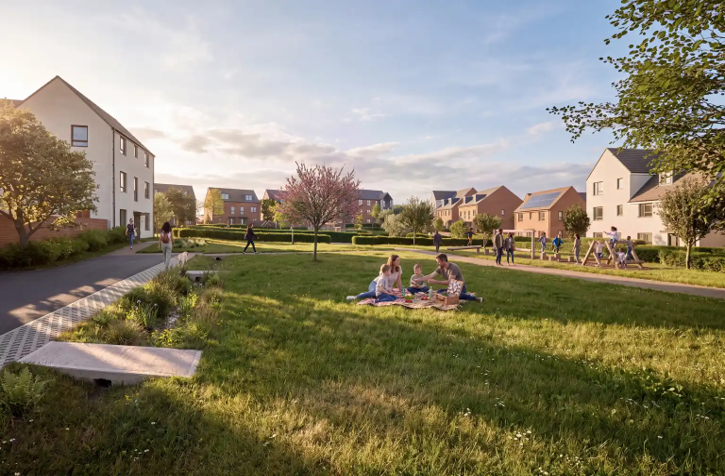
East Herts Council’s Development Management Committee approved the first 276 homes at Village 7 on 21 October, marking a significant milestone for Harlow and Gilston Garden Town, one of the country’s largest planned developments.
The plans include 65 affordable homes – 39 for affordable rent and 26 for shared ownership – within a mix of one to five-bedroom properties.
The village layout is designed to make walking, cycling and public transport practical alternatives to driving. Measures include separate walking and cycling routes through Church Lane Green, connections to the planned public transport corridor and more than 1,000 cycle parking spaces. Secure cycle storage within homes and apartment buildings, alongside visitor parking near play areas and green spaces, will help make cycling convenient for everyday journeys.
Raised community growing beds will give residents opportunities to grow food together, including spaces near apartments where private outdoor space is more limited. A foraging trail featuring fruiting plants will run through the neighbourhood, alongside a sensory garden offering a quieter place to sit and enjoy the surroundings.
A play area inspired by the area’s farming heritage will include references to rare British farm breeds. Five smaller ‘play-on-the-way’ spaces will provide opportunities for children to play along everyday walking and cycling routes.
Every home will also connect to a shared heating and hot-water network. The Community Heat Hub, approved as part of an earlier infrastructure application, will be operational before the first residents move in.
Village 7 is being delivered by Taylor Wimpey. Its masterplan, approved in April, also includes a new football hub and the restoration of listed barns for office and community use.
Councillor Maura Connolly, Executive Member for Planning and Growth at East Herts Council, said: “This is a major moment for Gilston. After years of planning, we have approved the first 276 homes, including 65 affordable homes, in a development that will shape this area for generations.
“But what makes Village 7 particularly exciting is how it brings people together – whether that’s growing food, sharing clean energy, playing sport or making use of historic buildings given a new purpose.
“These features matter. They help create a community, alongside the homes people need, and we want them to be central to how Gilston develops.”
Jonathan Locke, Head of Planning at Taylor Wimpey North Thames, said: “This approval is a big step forward for Village 7 and the Gilston area. We can now start work on what will become the gateway to a highly sustainable new community, with the first 276 homes being built at the same time as significant areas of new public green space that will allow people to relax, play and look after the planet.
“We have carefully designed our homes to be fit for the future. They combine attractive architecture and modern layouts with a range of eco-friendly features and construction measures to make them carbon net-zero ready.
“We are going much further than the requirements in our outline planning permission on carbon reduction and sustainability, both to create the best possible homes for future residents and to make a positive contribution towards the climate emergency.”
Harlow and Gilston Garden Town brings together plans for new homes, jobs, transport links and community facilities in and around Harlow, across the Hertfordshire and Essex border. The Gilston area will comprise seven new villages, with plans for 10,000 homes alongside schools, green spaces and other infrastructure.